




I-80 Expansion Project Frequently Asked Questions (FAQ)
As many of you are aware, the I-80 Expansion Project has been a topic of discussion in our region for several years. With final design plans now in motion and construction approaching, I believe it’s important to provide a clear, factual overview of what to expect and why this project is necessary, and where we go from here.
What is the I-80 Expansion Project?
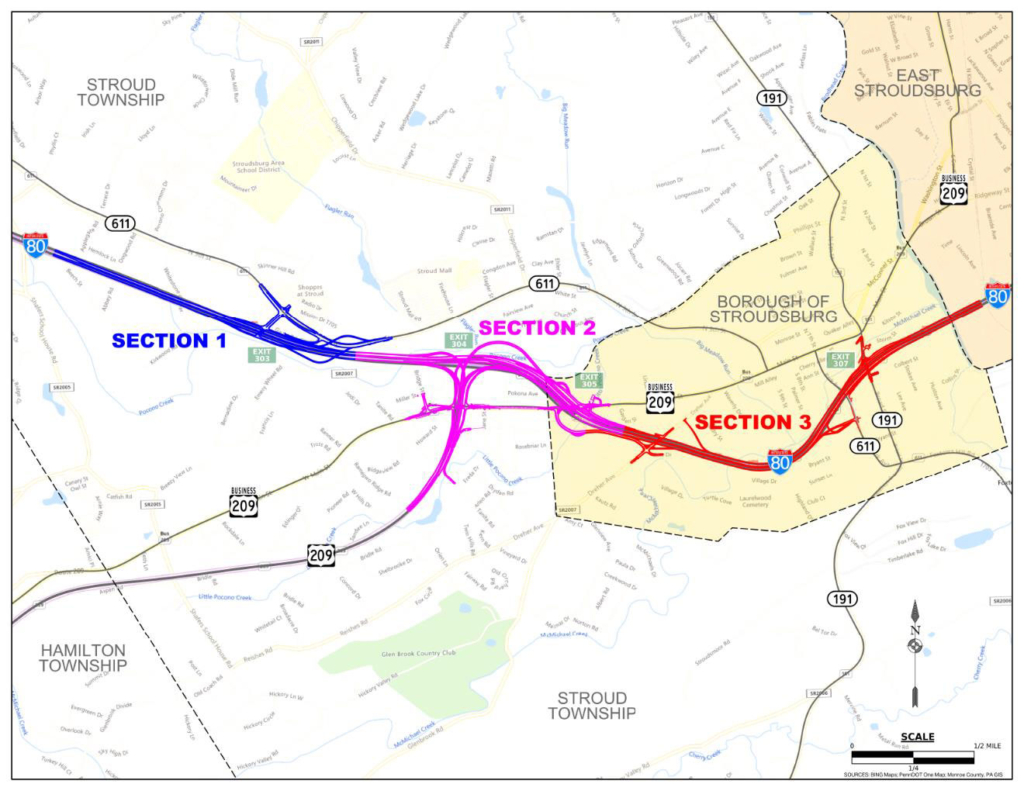
The I-80 Expansion Project will reconstruct and widen Interstate 80 from Exit 303 to Exit 308, expanding it to three lanes in each direction, redesigning interchanges, and improving access and safety.
Why is this project needed?
Originally built in the 1960s to handle 10,000 vehicles per day, I-80 now carries over 80,000 vehicles daily – 22% of which are trucks. By 2030–2040, daily traffic is expected to exceed 90,000–100,000 vehicles. The roadway no longer meets safety or design standards and experiences crash rates above the statewide average, particularly near Exit 304, which has been designated a Safety Corridor due to its high number of accidents. You can usually see the I-80 backups, especially on Friday or Sunday evenings during holiday seasons.
Are there crash or safety statistics available for the I-80 corridor under reconstruction?
Yes. Historical crash data for the 3.45-mile segment of I-80 being reconstructed showed crash rates above the statewide average, with a high number of rear-end, sideswipe, and fixed-object crashes. These patterns typical of congested areas with outdated design features.
Between 2008 and 2012, there were 239 reported crashes in this segment. Of those, 34% were fixed-object collisions and 31% were rear-end crashes.
More recently, from 2020 to 2024, there were an additional 256 crashes reported in the same area, underscoring the ongoing safety concerns and the need for reconstruction.
What are the planned improvements?
- Widening I-80 to three lanes each way
- Redesigning and reconstructing interchanges
- Raising bridges, removing and adding ramps
- Improving ramp geometry and access
- Creating flyover lanes and lengthening entrance/exit ramps
- Installing stormwater retention basins
What is the project timeline?
The final design was approved in January 2023. Construction is planned in three phases, moving from west to east starting at Exit 303. The project will be going out to big in 2026.
Did the public have input on the project?
Yes. The first public meeting was held in February 2014, with multiple meetings through 2019, leading up to the final design approval in 2023.
What is the cost and how is it funded?
The project is supported by over half a billion dollars in federal infrastructure funding. This investment reflects the federal and state obligation to maintain safe, modern, and efficient infrastructure. This is a significant investment of your tax money returning to our region that could have been invested to another area.
What about the reported bald eagle nest near the project site?
The presence of a bald eagle nest within 660 feet of the I-80 project area has triggered the need for formal consultation with both the U.S. Fish and Wildlife Service and the Pennsylvania Game Commission. PennDOT District 5-0 has already begun this consultation process and will continue working closely with these agencies throughout the final design phase.
Importantly, the section of the project where the nest is located falls within Phase 3, which is not scheduled to begin construction until late 2031 or early 2032. This extended timeline allows for careful environmental planning and review.
It’s also worth noting that bald eagles sometimes change nest locations over time. If this nest is no longer active when construction begins, no further action may be needed. If it remains in use, PennDOT will implement an agency-approved avoidance and minimization plan to ensure the project proceeds in compliance with federal and state wildlife protections.
In either scenario, an approved environmental strategy will be in place before construction near the nest begins.